Combating Misinformation on Social Media
Combating Misinformation on Social Media
Designing an In-Platform Fact-Checking Experience for Social Media
Designing an In-Platform Fact-Checking Experience for Social Media
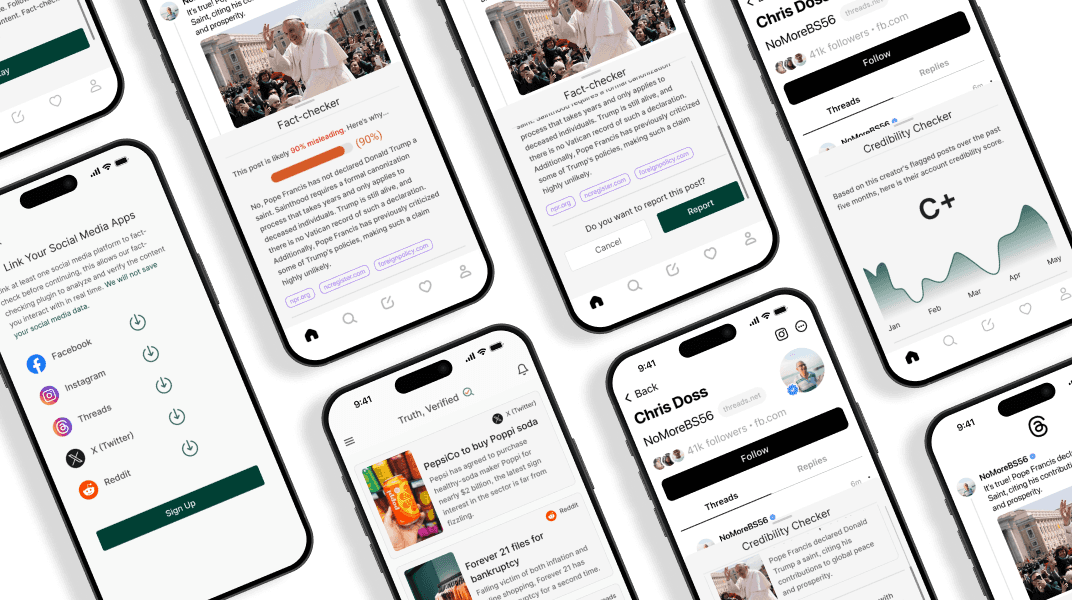
CONTENT
OVERVIEW
OVERVIEW
Social media is now a primary source of news consumption, yet the spread of misinformation makes it difficult for users to know what to trust. Few technological systems help users determine whether information is factual, which places the burden of fact checking on individual users.
In this project, I led a team research study to understand how people consume news and verify information on social media. I conducted contextual inquiries and interviews, led research synthesis, and carried insights forward by independently designing the solution through wireframing, prototyping, and usability testing.
Social media is now a primary source of news consumption, yet the spread of misinformation makes it difficult for users to know what to trust. Few technological systems help users determine whether information is factual, which places the burden of fact checking on individual users.
In this project, I led a team research study to understand how people consume news and verify information on social media. I conducted contextual inquiries and interviews, led research synthesis, and carried insights forward by independently designing the solution through wireframing, prototyping, and usability testing.
Methods:
Methods
Methods
Contextual Inquiry, User Interview, Qualitative Analysis, Affinity Mapping, Persona and Scenario Writing, Journey Mapping, Wireframing, Prototyping, and Usability Testing.
Contextual Inquiry, User Interview, Qualitative Analysis, Affinity Mapping, Persona and Scenario Writing, Journey Mapping, Wireframing, Prototyping, and Usability Testing.
Tools:
Tools
Tools
FigJam, Figma, ATLAS.ti, and Zoom.
FigJam, Figma, ATLAS.ti, and Zoom.
Duration:
Duration
Duration
11 weeks
11 weeks
Impact
Impact
The research revealed that the real challenge was the effort required to verify credibility. These insights informed a mobile plugin concept that integrates fact-checking into social media interactions, reducing the effort required for users to evaluate information.
The research revealed that the real challenge was the effort required to verify credibility. These insights informed a mobile plugin concept that integrates fact-checking into social media interactions, reducing the effort required for users to evaluate information.
PROBLEM SPACE
PROBLEM SPACE
Verifying information on social media requires effort many users will not sustain.
Verifying information on social media requires effort many users will not sustain.
Misinformation spreads rapidly across social media platforms, yet users lack efficient ways to evaluate credibility. Verifying information requires critical thinking and manual research, which often leads users to abandon the process before reaching a clear conclusion.
Misinformation spreads rapidly across social media platforms, yet users lack efficient ways to evaluate credibility. Verifying information requires critical thinking and manual research, which often leads users to abandon the process before reaching a clear conclusion.
Central Question:
How might technology help users understand what is trustworthy on social media without disrupting their browsing experience?
Central Question:
How might technology help users understand what is trustworthy on social media without disrupting their browsing experience?
COMPETITIVE REVIEW
COMPETITIVE REVIEW
Existing fact-checking tools revealed gaps in everyday misinformation verification.
Existing fact-checking tools revealed gaps in everyday misinformation verification.
I reviewed existing fact-checking tools to understand how current systems support credibility evaluation.
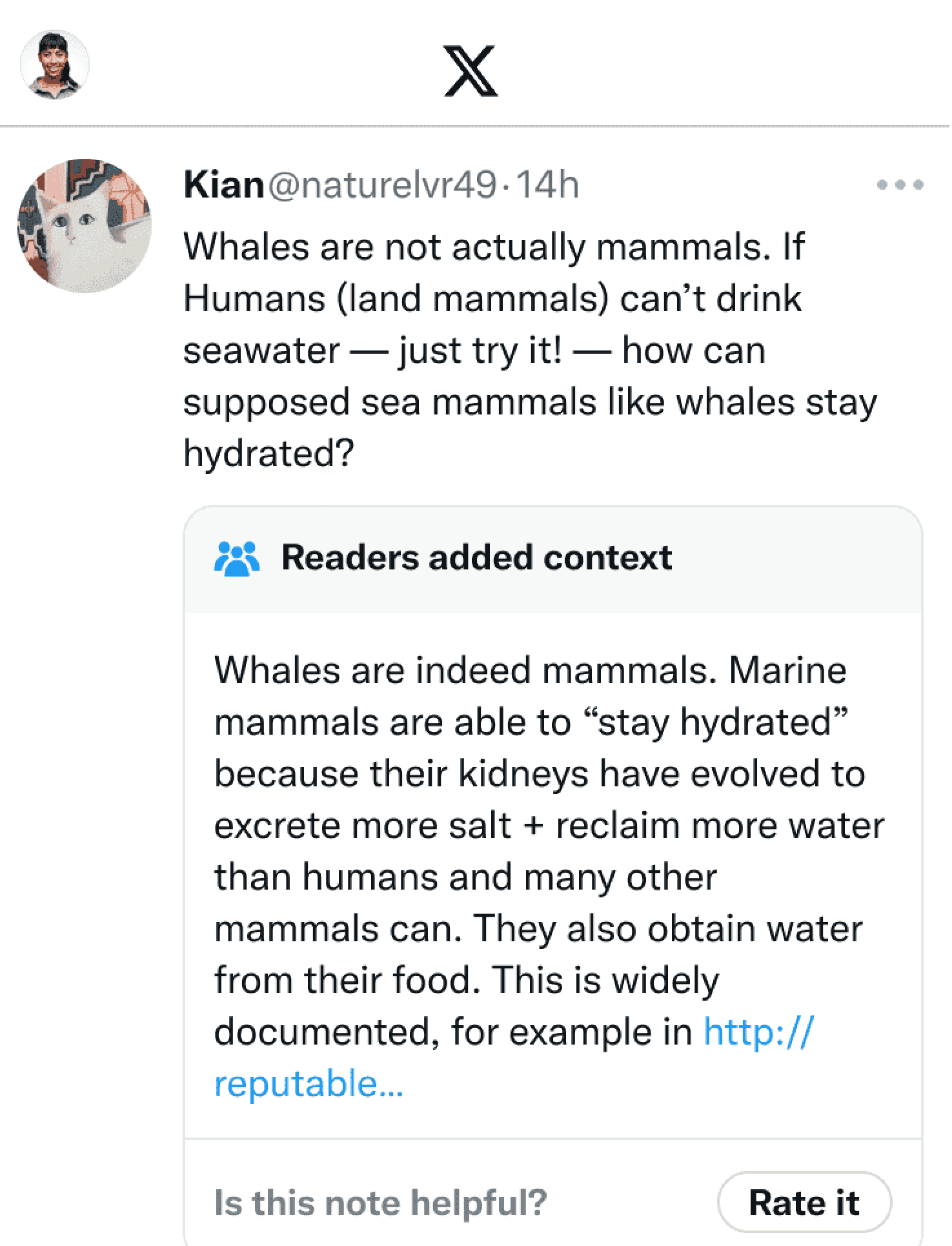
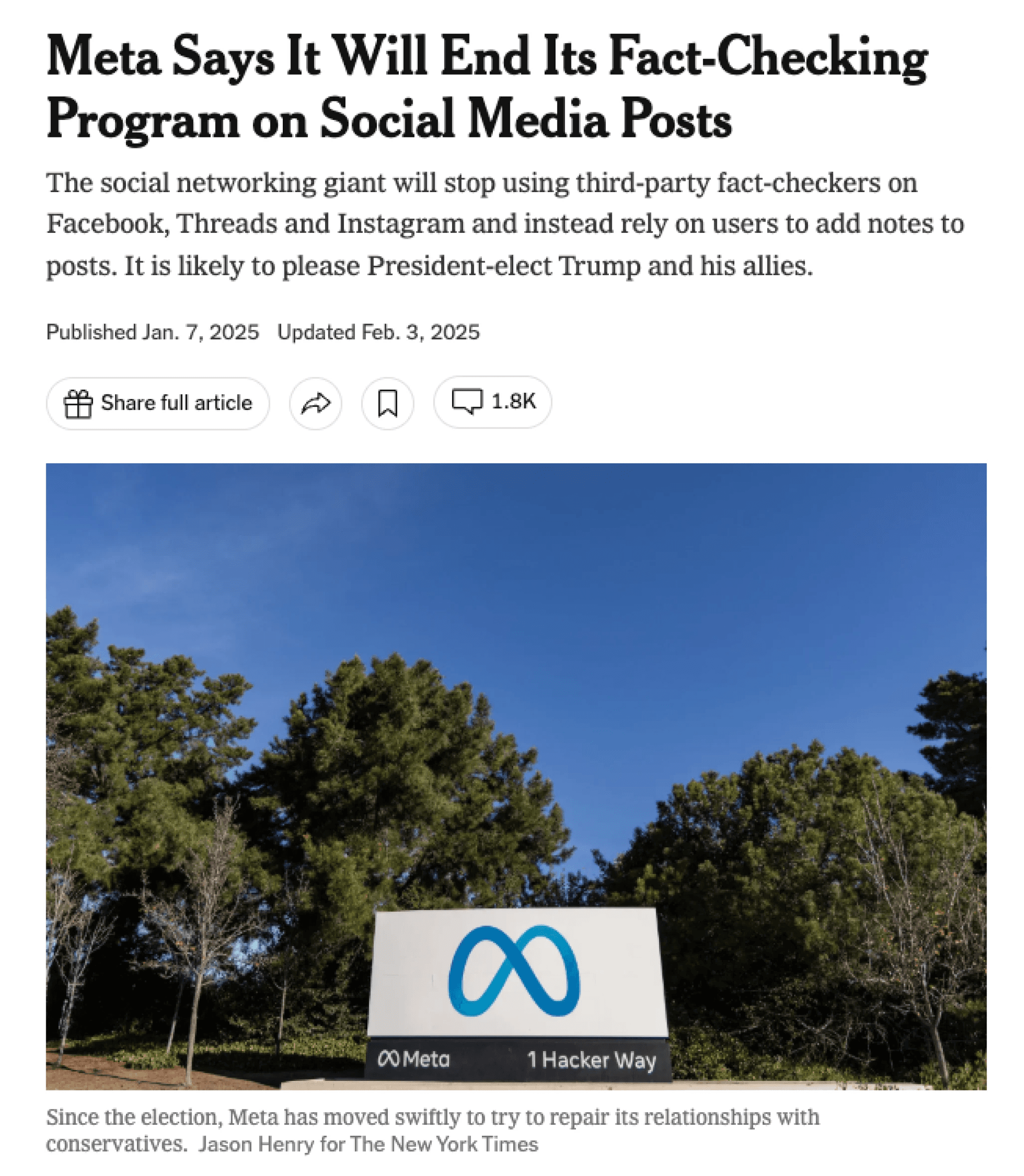
Features like X’s Community Notes and Facebook’s third party fact checking attempt to flag misleading content but often face criticism for limited coverage and inconsistent results.
I reviewed existing fact-checking tools to understand how current systems support credibility evaluation.
Features like X’s Community Notes and Facebook’s third party fact checking attempt to flag misleading content but often face criticism for limited coverage and inconsistent results.
Plugins such as NewsGuard focus mainly on news outlets, even though misinformation often spreads through individual posts. Most tools are also desktop focused, while social media use is largely mobile.
These gaps suggested an opportunity to embed credibility signals directly into everyday social media interactions.
Plugins such as NewsGuard focus mainly on news outlets, even though misinformation often spreads through individual posts. Most tools are also desktop focused, while social media use is largely mobile.
These gaps suggested an opportunity to embed credibility signals directly into everyday social media interactions.
CONTEXTUAL INQUIRY
CONTEXTUAL INQUIRY
Fact-checking is often brief and many stops before verification is complete.
Fact-checking is often brief and many stops before verification is complete.
To understand how people verify information in real situations, we conducted contextual inquiries with 6 participants.
Participants screen shared while fact-checking a fabricated Facebook post titled “Pope Francis declared Donald Trump a Saint.” The goal was to observe how users verify questionable content in real time.
To understand how people verify information in real situations, we conducted contextual inquiries with six participants.
Participants screen shared while fact-checking a fabricated Facebook post titled “Pope Francis declared Donald Trump a Saint.” The goal was to observe how users verify questionable content in real time.

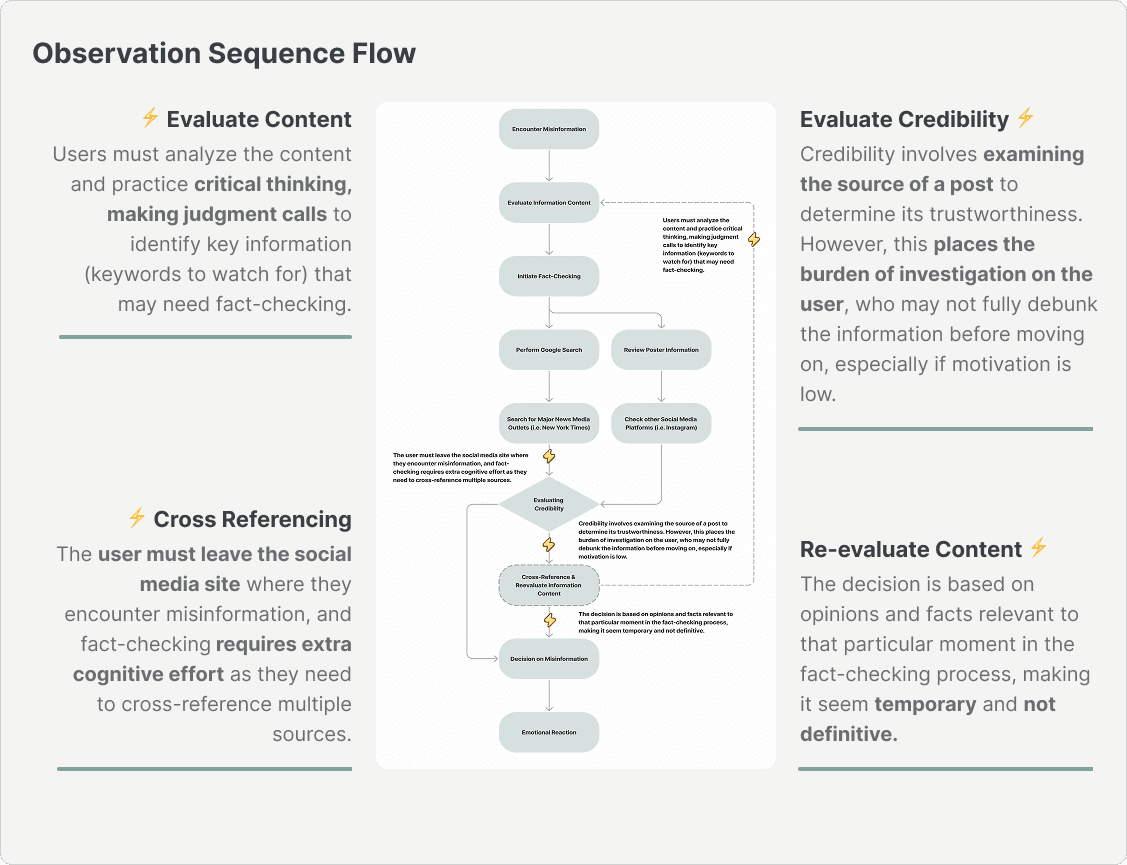
This revealed key behaviors and breakdowns in the verification process, which I mapped in an observation sequence flow.
This revealed key behaviors and breakdowns in the verification process, which I mapped in an observation sequence flow.
Observation Insight
Observation Insight
The observation revealed that fact-checking is often brief and incomplete. Participants typically spent about five minutes verifying a claim before stopping the process, even when the information remained unresolved.
The observation revealed that fact-checking is often brief and incomplete. Participants typically spent about five minutes verifying a claim before stopping the process, even when the information remained unresolved.
USER INTERVIEW
USER INTERVIEW
Convenience and platform cues shape how users judge credibility.
Convenience and platform cues shape how users judge credibility.
We conducted 8 semi-structured interviews to understand how people consume social media content and decide whether to fact-check information, identifying two key learnings below.
We conducted 8 semi-structured interviews to understand how people consume social media content and decide whether to fact-check information, identifying two key learnings below.
News Consumption Habits
News Consumption Habits
Participants explained that convenience strongly shapes social media consumption. Many rely on platforms like Instagram and Reddit because information appears in short and digestible formats.
Participants explained that convenience strongly shapes social media consumption. Many rely on platforms like Instagram and Reddit because information appears in short and digestible formats.
Credibility Assesment
Credibility Assesment
Trust depends on the platform, the account owner, and the source. Content from credible verified accounts on Instagram or Reddit is seen as more trustworthy than posts from random users on Facebook.
Trust depends on the platform, the account owner, and the source. Content from credible verified accounts on Instagram or Reddit is seen as more trustworthy than posts from random users on Facebook.
RESEARCH SYNTHESIS
RESEARCH SYNTHESIS
Synthesis revealed that effort is the real barrier to verifying information.
Synthesis revealed that effort is the real barrier to verifying information.
I synthesized findings using ATLAS.ti for descriptive coding and FigJam to organize observations and interview data into affinity diagrams.
I synthesized findings using ATLAS.ti for descriptive coding and FigJam to organize observations and interview data into affinity diagrams.

Across both studies, one pattern emerged. Users must identify suspicious claims, search for sources, and judge credibility. This requires cognitive effort and often leads to incomplete verification.
Across both studies, one pattern emerged. Users must identify suspicious claims, search for sources, and judge credibility. This requires cognitive effort and often leads to incomplete verification.
Key Insight:
The core challenge was the effort required to verify credibility.
Key Insight:
The core challenge was the effort required to verify credibility.
Research Limitations
Research Limitations
Representation Gaps
Representation Gaps
The interview sample lacked right-wing conservatives and participants over 35. Future research should include Gen X and Boomer participants to improve representation.
The interview sample lacked right-wing conservatives and participants over 35. Future research should include Gen X and Boomer participants to improve representation.
Device Context
Device Context
Most observations were conducted on laptops, even though social media is primarily accessed on mobile devices. Future studies should include phones and tablets.
Most observations were conducted on laptops, even though social media is primarily accessed on mobile devices. Future studies should include phones and tablets.
DESIGN OPPORTUNITY
DESIGN OPPORTUNITY
Embedding verification within social media browsing became the design opportunity.
Embedding verification within social media browsing became the design opportunity.
I realized from our research that there’s opportunity to embed credibility signals directly within the browsing experience, allowing users to evaluate information without interrupting their flow.
This insight shaped the concept of an in-platform fact-checking tool designed to reduce the effort required to verify credibility.
I realized from our research that there’s opportunity to embed credibility signals directly within the browsing experience, allowing users to evaluate information without interrupting their flow.
This insight shaped the concept of an in-platform fact-checking tool designed to reduce the effort required to verify credibility.
PERSONA CREATION
PERSONA CREATION
Two user types revealed distinct social media habits and fact-checking motivations.
Two user types revealed distinct social media habits and fact-checking motivations.
To better understand our potential user audience, we grouped participants based on shared demographics and interview responses and created patterns to capture how different motivations shape fact-checking behavior. Two distinct patterns emerged.
To better understand our potential user audience, we grouped participants based on shared demographics and interview responses and created patterns to capture how different motivations shape fact-checking behavior. Two distinct patterns emerged.
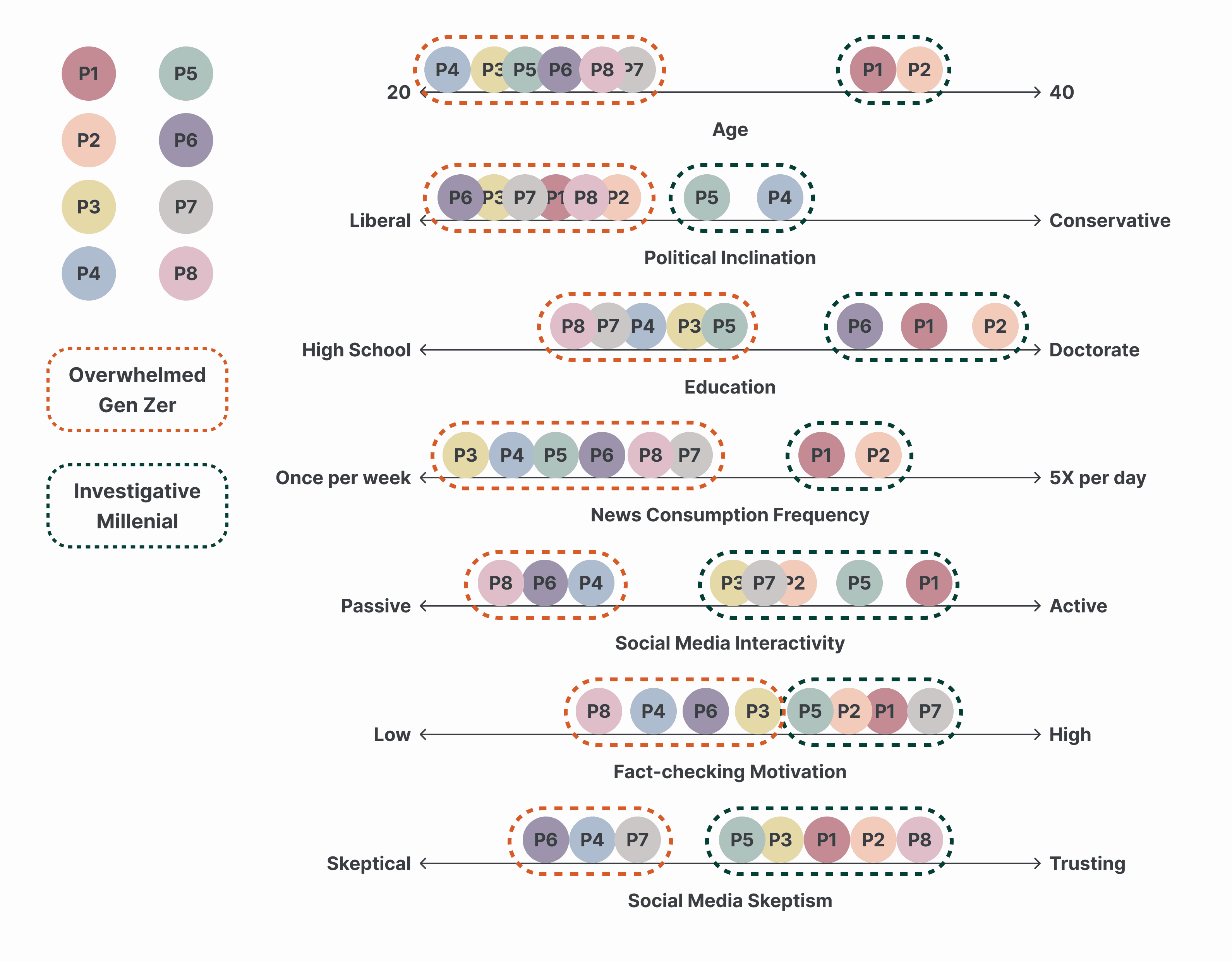
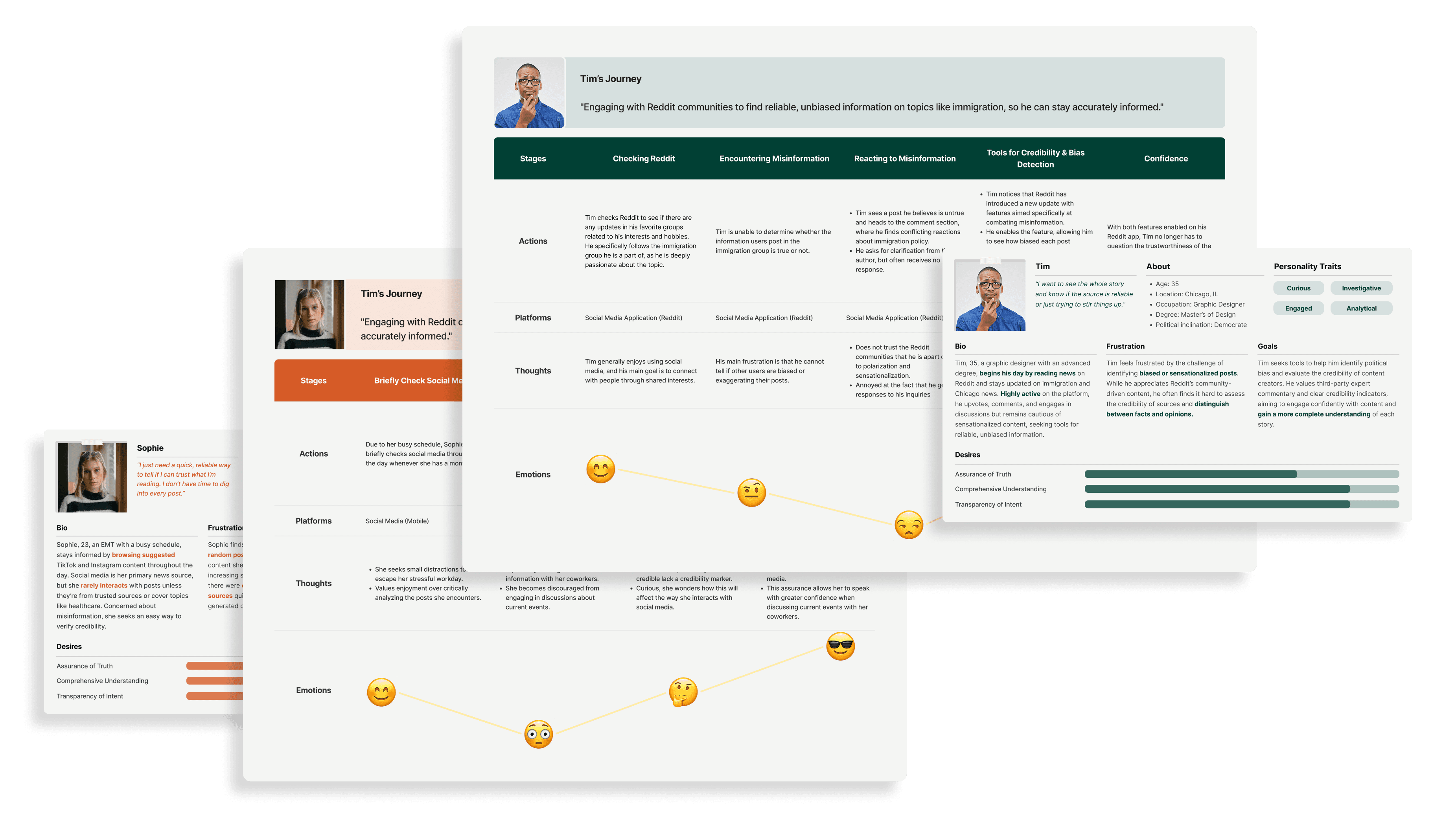
We created two personas and journey maps clarifying why some users investigate misinformation while others move past it, guiding how the design could reduce the effort required to evaluate credibility. The two distinct user groups are:
We created two personas and journey maps clarifying why some users investigate misinformation while others move past it, guiding how the design could reduce the effort required to evaluate credibility. The two distinct user groups are:
Investigative Millennial
Investigative Millennial
More likely to engage critically with posts and verify information before forming an opinion.
More likely to engage critically with posts and verify information before forming an opinion.
Overwhelmed Gen Zer
Overwhelmed Gen Zer
More likely to scroll passively, using social media as a break and rarely pausing to verify questionable content.
More likely to scroll passively, using social media as a break and rarely pausing to verify questionable content.
IDEATION
IDEATION
Selecting three priority features shaped the wireframe concepts.
Selecting three priority features shaped the wireframe concepts.
To translate research insights into design opportunities, we brainstormed 11 potential features and evaluated them using a priority matrix based on impact and feasibility.
From this analysis, I selected three features that balanced user value and feasibility, then created mobile wireframes since most social media content is consumed on phones.
To translate research insights into design opportunities, we brainstormed 11 potential features and evaluated them using a priority matrix based on impact and feasibility.
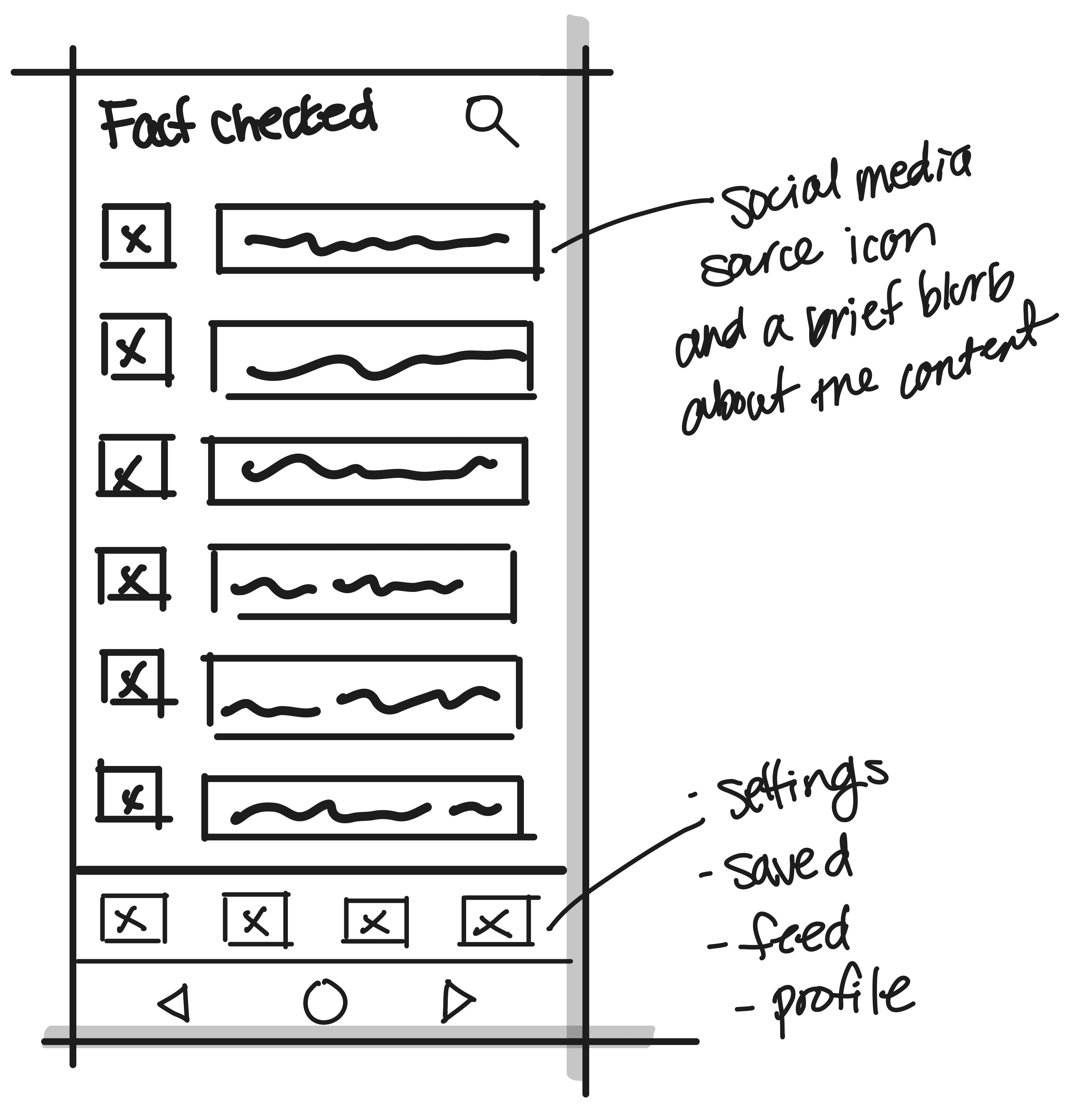
From this analysis, I selected three features that balanced user value and feasibility, then created mobile wireframes since most social media content is consumed on phones.
Verified Content:
Verified Content
Verified Content
Surfaces trusted content so users can browse credible information without verifying.
Surfaces trusted content so users can browse credible information without verifying.
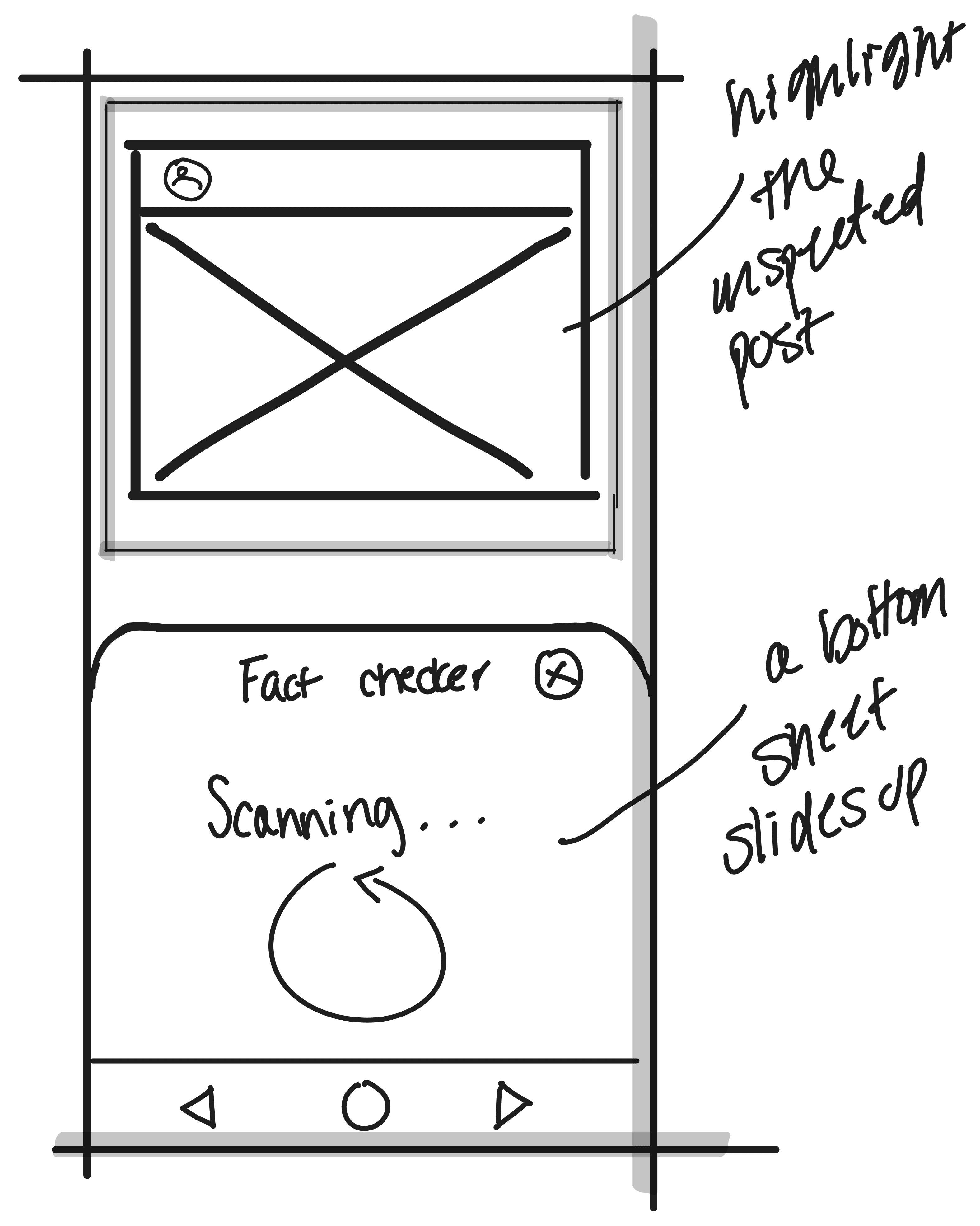
Fact-Checker Tool:
Fact-Checker Tool
Fact-Checker Tool
Allows users to verify claims instantly within the platform.
Allows users to verify claims instantly within the platform.
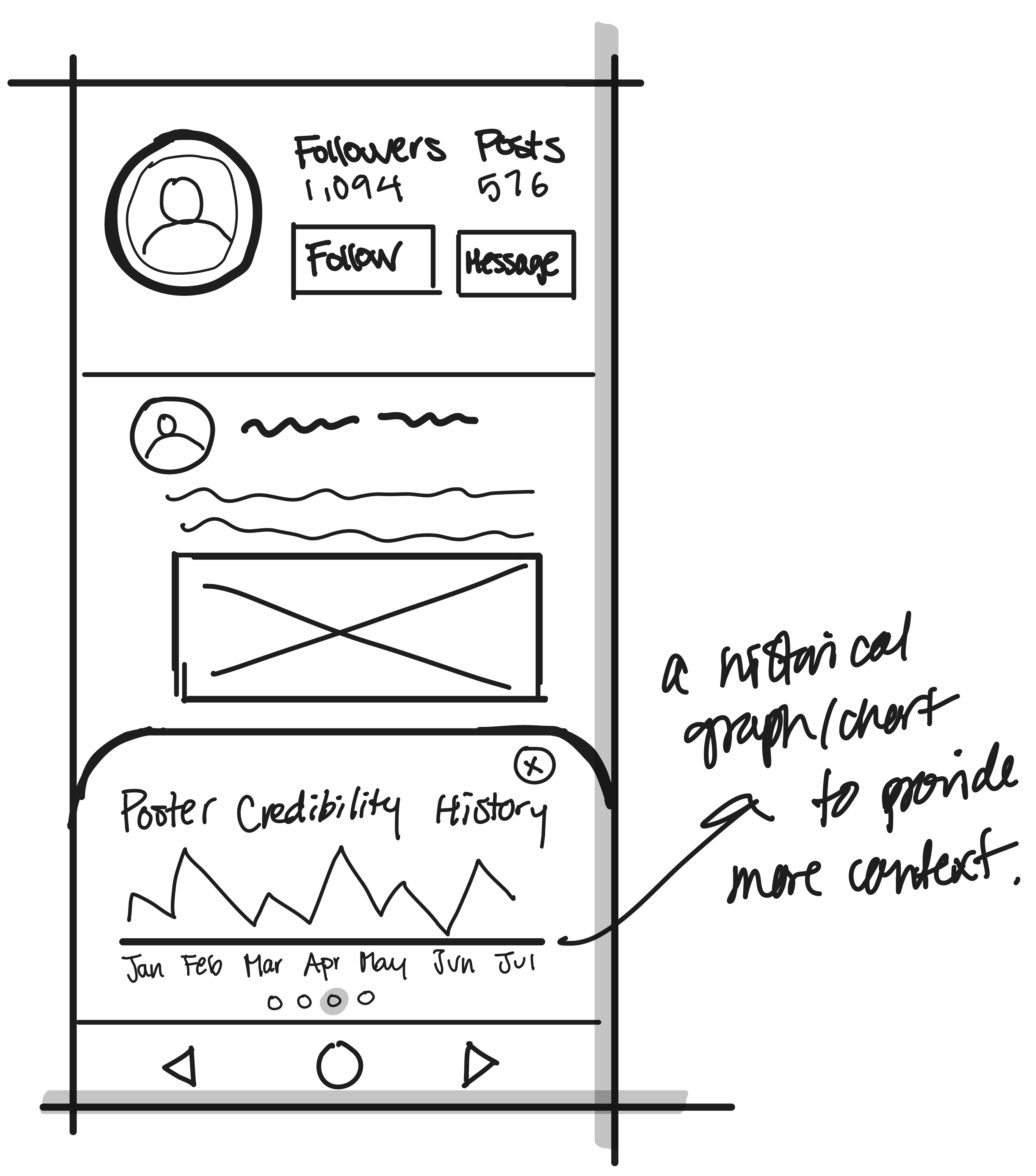
Credibility Sensor:
Credibility Sensor
Credibility Sensor
Displays visual credibility indicators based on a creator’s misinformation history.
Displays visual credibility indicators based on a creator’s misinformation history.
MID-FIDELITY PROTOTYPE
MID-FIDELITY PROTOTYPE
Prototyping explored how verification could fit into social media browsing.
Prototyping explored how verification could fit into social media browsing.
I translated the wireframe sketches into a mid-fidelity mobile prototype in Figma. The prototype supported three key tasks.
I translated the wireframe sketches into a mid-fidelity mobile prototype in Figma. The prototype supported three key tasks.
Verified Content:
Sign up and sync platforms to curate trustworthy content.
Hover To Play
Verified Content
Sign up and sync platforms to curate trustworthy content in one newsfeed.
Verified Content
Sign up and sync platforms to curate trustworthy content in one newsfeed.
Fact-Checker Tool:
Fact-check a misleading social media post.
Hover To Play
Fact-Checker Tool
Using the fact-checking feature to debunk a misleading social media post.
Fact-Checker Tool
Using the fact-checking feature to debunk a misleading social media post.
Credibility Sensor:
View a creator’s credibility level.
Hover To Play
Credibility Sensor
Review a creator’s credibility score based on past misleading posts.
Credibility Sensor
Review a creator’s credibility score based on past misleading posts.
USER TESTING
USER TESTING
User testing validated the layout and revealed opportunities to improve clarity and transparency.
User testing validated the layout and revealed opportunities to improve clarity and transparency.
I conducted moderated semi-structured usability testing with 2 participants to evaluate usability and clarity while completing the three tasks identified in the mid-fi prototype.
I conducted moderated semi-structured usability testing with 2 participants to evaluate usability and clarity while completing the three tasks identified in the mid-fi prototype.
Key Findings
Key Findings
Overall feedback was positive, with findings revealing design strengths and areas for improvement.
Overall feedback was positive, with findings revealing design strengths and areas for improvement.
Layout rated highly for clarity (5/5) and navigation (4.5/5).
Layout rated highly for clarity (5/5) and navigation (4.5/5).
User expected a privacy explanation during sign-up.
User expected a privacy explanation during sign-up.
User suggested a clearer visual hierarchy in fact-checker results.
User suggested a clearer visual hierarchy in fact-checker results.
User expressed value in transparency by including the most flagged posts.
User expressed value in transparency by including the most flagged posts.
These insights informed refinements in the final design.
These insights informed refinements in the final design.
Limitations
Limitations
User testing included only 2 participants, which limits generalizability. Future testing should include a larger sample size.
User testing included only 2 participants, which limits generalizability. Future testing should include a larger sample size.
FINAL DESIGN
FINAL DESIGN
The final concept embeds fact-checking directly within the social media browsing experience, and improving clarity and transparency.
The final concept embeds fact-checking directly within the social media browsing experience, and improving clarity and transparency.
I created the final prototype in Figma by refining the design based on testing feedback. Improvements included:
I created the final prototype in Figma by refining the design based on testing feedback. Improvements included:
Clearer privacy messaging during sign-up.
Clearer privacy messaging during sign-up.
Easier-to-understand fact-checker result summaries.
Easier-to-understand fact-checker result summaries.
Added a section for the most recently flagged posts.
Added a section for the most recently flagged posts.
The final concept demonstrates how fact-checking can become a seamless part of social media browsing, allowing users to evaluate credibility instantly rather than abandoning verification.
The final concept demonstrates how fact-checking can become a seamless part of social media browsing, allowing users to evaluate credibility instantly rather than abandoning verification.
Verified Content
Verified Content
Hover To Play
Fact-Checker Tool
Fact-Checker Tool
Hover To Play
Credibility Sensor
Credibility Sensor
Hover To Play
CONCLUSION
CONCLUSION
Reducing verification effort became the core design outcome.
Reducing verification effort became the core design outcome.
Impact
Impact
Our research showed that fact-checking requires effort, motivation, and critical thinking, which often discourages users from verifying information. This project introduces an in platform fact-checking concept that allows users to verify social media posts without leaving their browsing experience. By embedding credibility signals directly into the interface, the design shifts greater control to information consumers rather than content creators.
Our research showed that fact-checking requires effort, motivation, and critical thinking, which often discourages users from verifying information. This project introduces an in platform fact-checking concept that allows users to verify social media posts without leaving their browsing experience. By embedding credibility signals directly into the interface, the design shifts greater control to information consumers rather than content creators.
Retrospective
Retrospective
If revisiting this project, I would address several research limitations. The participant sample did not include Gen X or Boomer users, even though older generations are often more vulnerable to misinformation. Participants were observed fact-checking on desktop computers rather than mobile phones, which does not fully reflect how social media is typically used. And usability testing also included only two participants, which limits the strength of the findings. Future research should include a broader age range, larger testing sample, and mobile based observation to better capture real world behavior and strengthen the findings.
If revisiting this project, I would address several research limitations. The participant sample did not include Gen X or Boomer users, even though older generations are often more vulnerable to misinformation. Participants were observed fact-checking on desktop computers rather than mobile phones, which does not fully reflect how social media is typically used. And usability testing also included only two participants, which limits the strength of the findings. Future research should include a broader age range, larger testing sample, and mobile based observation to better capture real world behavior and strengthen the findings.