Career Highways AI Integration
Career Highways AI Integration
Redesigning Career Exploration Experience by Integrating Artificial Intelligence
Redesigning Career Exploration Experience by Integrating Artificial Intelligence
CONTENT
OVERVIEW
OVERVIEW
Career Highways is a web platform that helps high school students explore and plan career pathways. During my internship at PUSH Studio, I explored how AI could enhance the Explore experience while preserving familiar search behaviors.
As a UX/UI Designer, I iteratively prototyped two AI interaction models, a conversational chatbot and a recommendation based system. And I conducted usability testing to evaluate how each AI model supports exploration.
Career Highways is a web platform that helps high school students explore and plan career pathways. During my internship at PUSH Studio, I explored how AI could enhance the Explore experience while preserving familiar search behaviors.
As a UX/UI Designer, I iteratively prototyped two AI interaction models, a conversational chatbot and a recommendation based system. And I conducted usability testing to evaluate how each AI model supports exploration.
Team:
Team
Team
I collaborated with an AI Engineer, PUSH Design Director, and the Client.
I collaborated with an AI Engineer, PUSH Design Director, and the Client.
Methods:
Methods
Methods
Iterative prototyping, and usability testing.
Iterative prototyping, and usability testing.
Tools:
Tools
Tools
Figma, FigJam, Jira, and Zoom.
Figma, FigJam, Jira, and Zoom.
Duration:
Duration
Duration
6 weeks
6 weeks
Impact
Impact
The project revealed how combining two AI interaction models with classic search can support different exploration behaviors without disrupting familiar workflows. It also surfaced an opportunity to consolidate four separate Explore pages into a single discovery experience.
The project revealed how combining two AI interaction models with classic search can support different exploration behaviors without disrupting familiar workflows. It also surfaced an opportunity to consolidate four separate Explore pages into a single discovery experience.
PROBLEM SPACE
PROBLEM SPACE
Introducing AI without disrupting familiar search behavior is the core design challenge.
Introducing AI without disrupting familiar search behavior is the core design challenge.
The Career Highways Explore experience already supported discovery through keyword search and traditional filters. The challenge was integrating AI in a way that felt intuitive while minimizing disruption to an established workflow.
The Career Highways Explore experience already supported discovery through keyword search and traditional filters. The challenge was integrating AI in a way that felt intuitive while minimizing disruption to an established workflow.
Central Question:
How might we integrate AI into the Explore experience in a way that feels intuitive to users while minimizing disruption to the existing workflow?
Central Question:
How might we integrate AI into the Explore experience in a way that feels intuitive to users while minimizing disruption to the existing workflow?
CONTEXT
CONTEXT
The existing Explore experience fragmented discovery across multiple pages.
The existing Explore experience fragmented discovery across multiple pages.
The Career Highways Explore experience helps students discover career paths, jobs, certifications, and courses. Before this project, these categories were separated across four different Explore pages. Users often repeated similar searches when moving between them and had to figure out how each experience was related.
The Career Highways Explore experience helps students discover career paths, jobs, certifications, and courses. Before this project, these categories were separated across four different Explore pages. Users often repeated similar searches when moving between them and had to figure out how each experience was related.
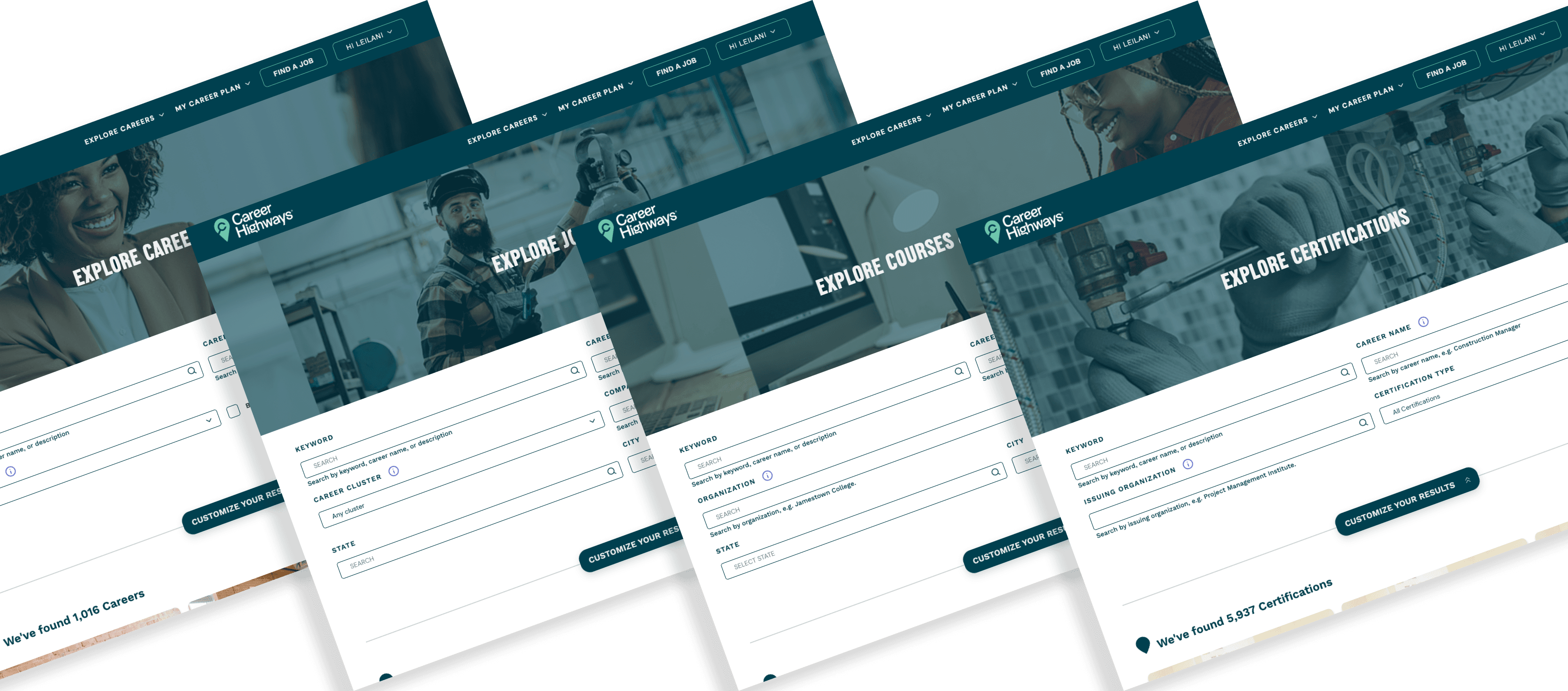
The project began with a client request to introduce prominent AI capabilities while maintaining familiarity for returning users, which introduced several design constraints throughout the project including:
The project began with a client request to introduce prominent AI capabilities while maintaining familiarity for returning users, which introduced several design constraints throughout the project including:
Overlapping systems
Overlapping systems
AI, keyword search, and filters appearing together made system behavior unclear.
AI, keyword search, and filters appearing together made system behavior unclear.
Fragmented exploration
Fragmented exploration
Related content lived across multiple pages, increasing mental effort.
Related content lived across multiple pages, increasing mental effort.
AI visibility versus screen space
AI visibility versus screen space
Prominent AI chatbot layouts reduced space for browsing results.
Prominent AI chatbot layouts reduced space for browsing results.
EARLY DIRECTION
EARLY DIRECTION
Early concepts explored conversational AI as the primary exploration tool.
Early concepts explored conversational AI as the primary exploration tool.
The early concept centered on an AI chatbot interface that encourages active exploration. This quickly surfaced a tension in integrating AI with traditional search in the same flow. Through rapid high-fidelity iteration, I explored an “under the hood” approach where AI guides exploration while classic search and filters remain available behind it.
The initial design included the following:
The early concept centered on an AI chatbot interface that encourages active exploration. This quickly surfaced a tension in integrating AI with traditional search in the same flow. Through rapid high-fidelity iteration, I explored an “under the hood” approach where AI guides exploration while classic search and filters remain available behind it.
The initial design included the following:
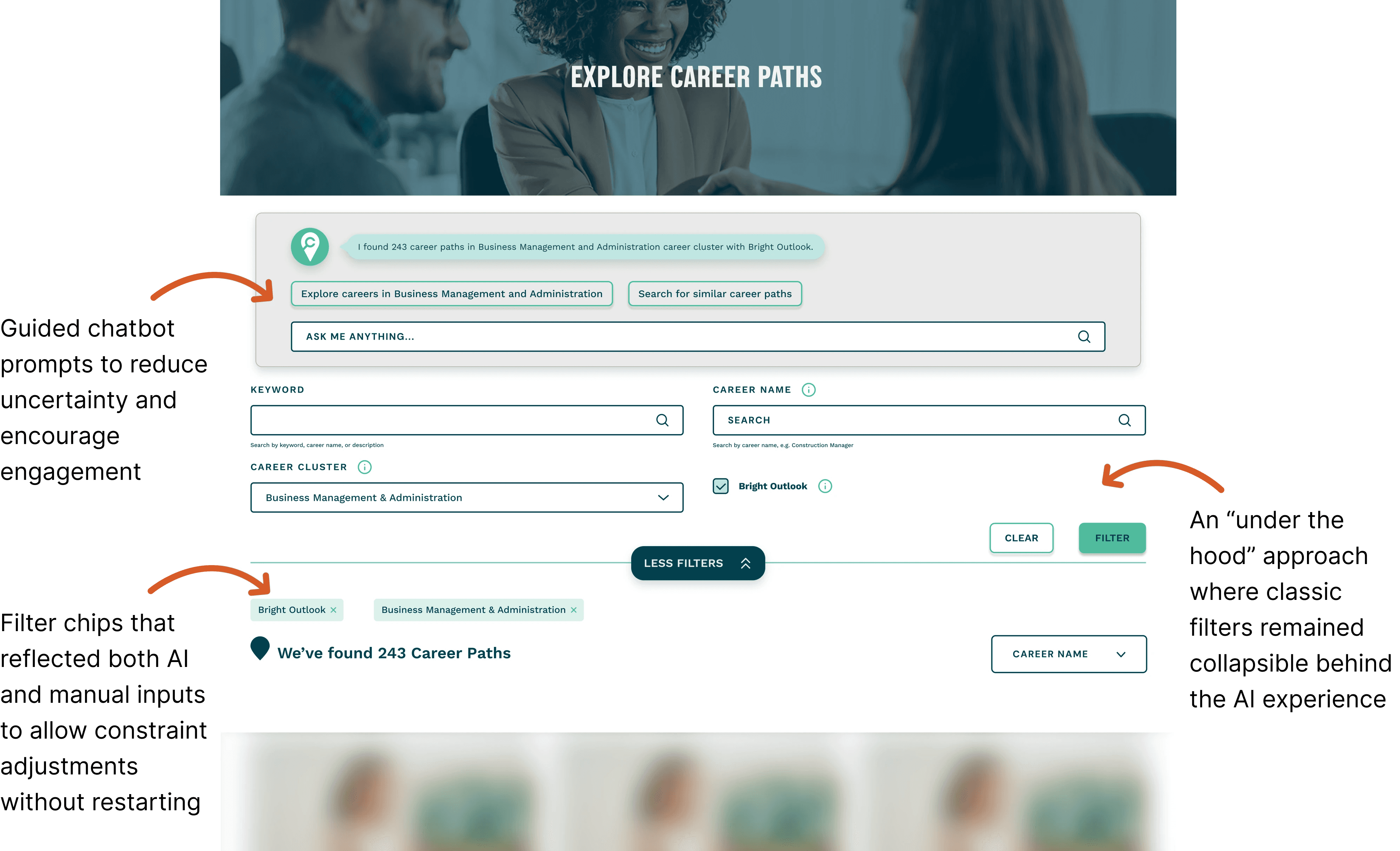
Based on early feedback, I removed filter chips while reinforcing AI visibility.
Based on early feedback, I removed filter chips while reinforcing AI visibility.
AI VS. CLASSIC SEARCH
AI VS. CLASSIC SEARCH
Separating AI and classic search clarified how users entered the experience.
Separating AI and classic search clarified how users entered the experience.
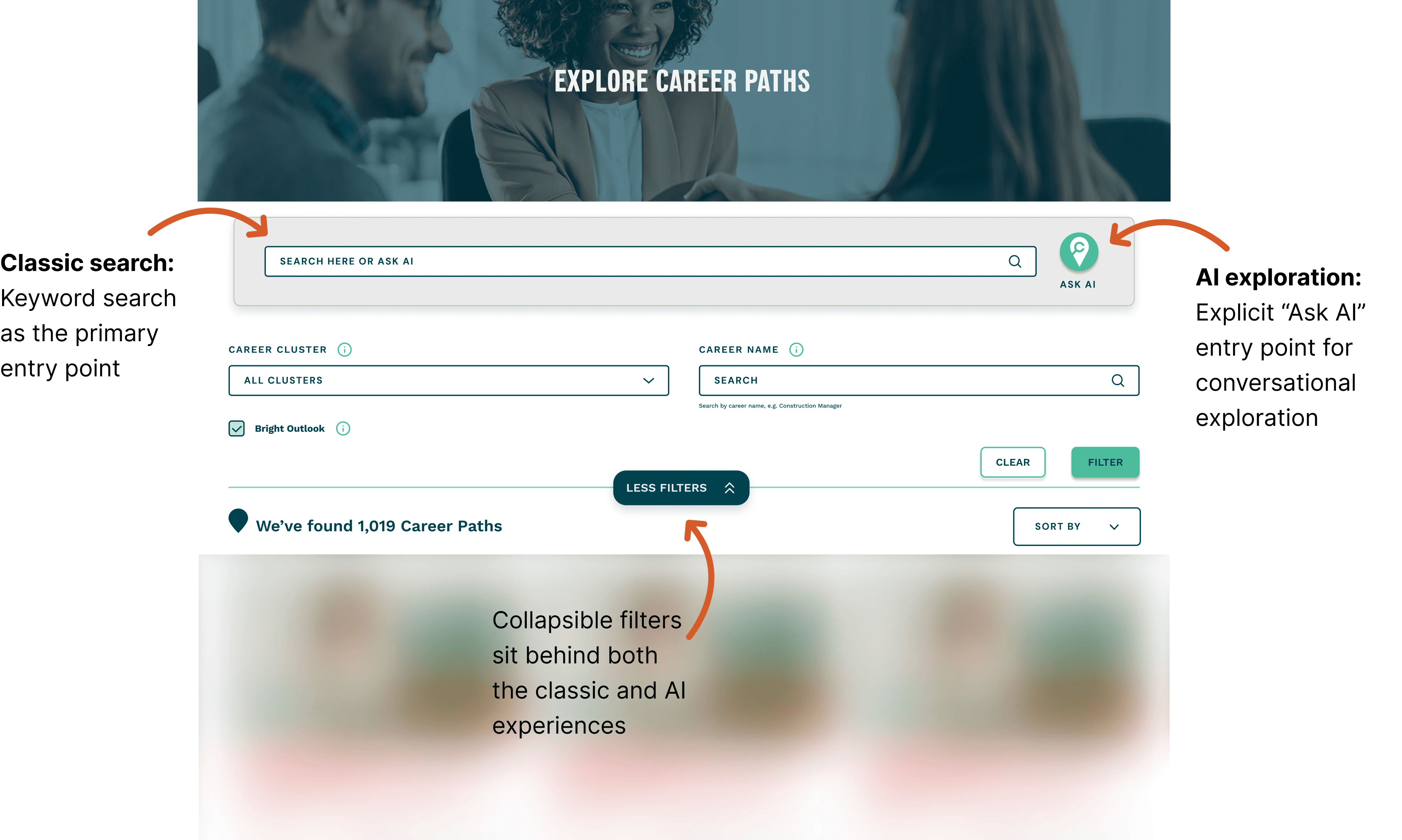
When the AI Engineer joined the project, concerns surfaced about users might be unintentionally pushed into AI. In response, I redesigned the interface to separate AI-assisted exploration from classic keyword search, allowing users to choose how they explore.
When the AI Engineer joined the project, concerns surfaced about users might be unintentionally pushed into AI. In response, I redesigned the interface to separate AI-assisted exploration from classic keyword search, allowing users to choose how they explore.
MODE SWITCH
MODE SWITCH
Introducing a toggle allowed users to switch exploration modes without losing context.
Introducing a toggle allowed users to switch exploration modes without losing context.
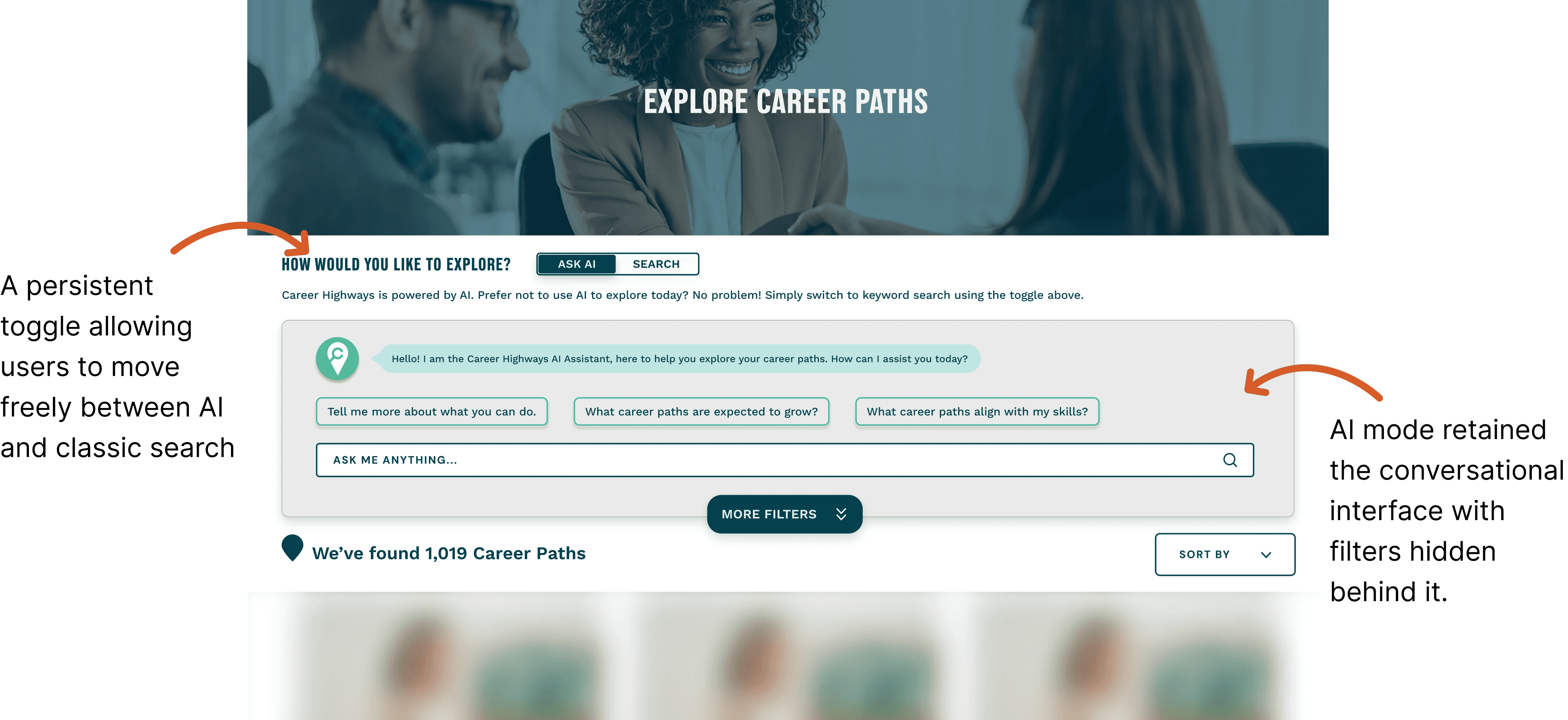
Further feedback showed users needed flexibility to switch modes mid-exploration. In response, I introduced a persistent toggle that allowed users to move between AI and classic search without losing context.
Further feedback showed users needed flexibility to switch modes mid-exploration. In response, I introduced a persistent toggle that allowed users to move between AI and classic search without losing context.
RECOMMENDATION MODEL
RECOMMENDATION MODEL
A recommendation model revealed an opportunity to consolidate four separate Explore pages into one experience.
A recommendation model revealed an opportunity to consolidate four separate Explore pages into one experience.
The recommendation model began as a design judgment call, rather than a fully validated direction. I questioned whether a chatbot alone supported early-stage exploration, especially for high school students who may not yet know what to search for.
Instead of treating this as a final solution, I introduced the recommendation model as a testable alternative. Its purpose was to explore whether a more passive, content-driven experience felt easier or more engaging than conversational input
The recommendation model design included the following:
The recommendation model began as a design judgment call, rather than a fully validated direction. I questioned whether a chatbot alone supported early-stage exploration, especially for high school students who may not yet know what to search for.
Instead of treating this as a final solution, I introduced the recommendation model as a testable alternative. Its purpose was to explore whether a more passive, content-driven experience felt easier or more engaging than conversational input
The recommendation model design included the following:
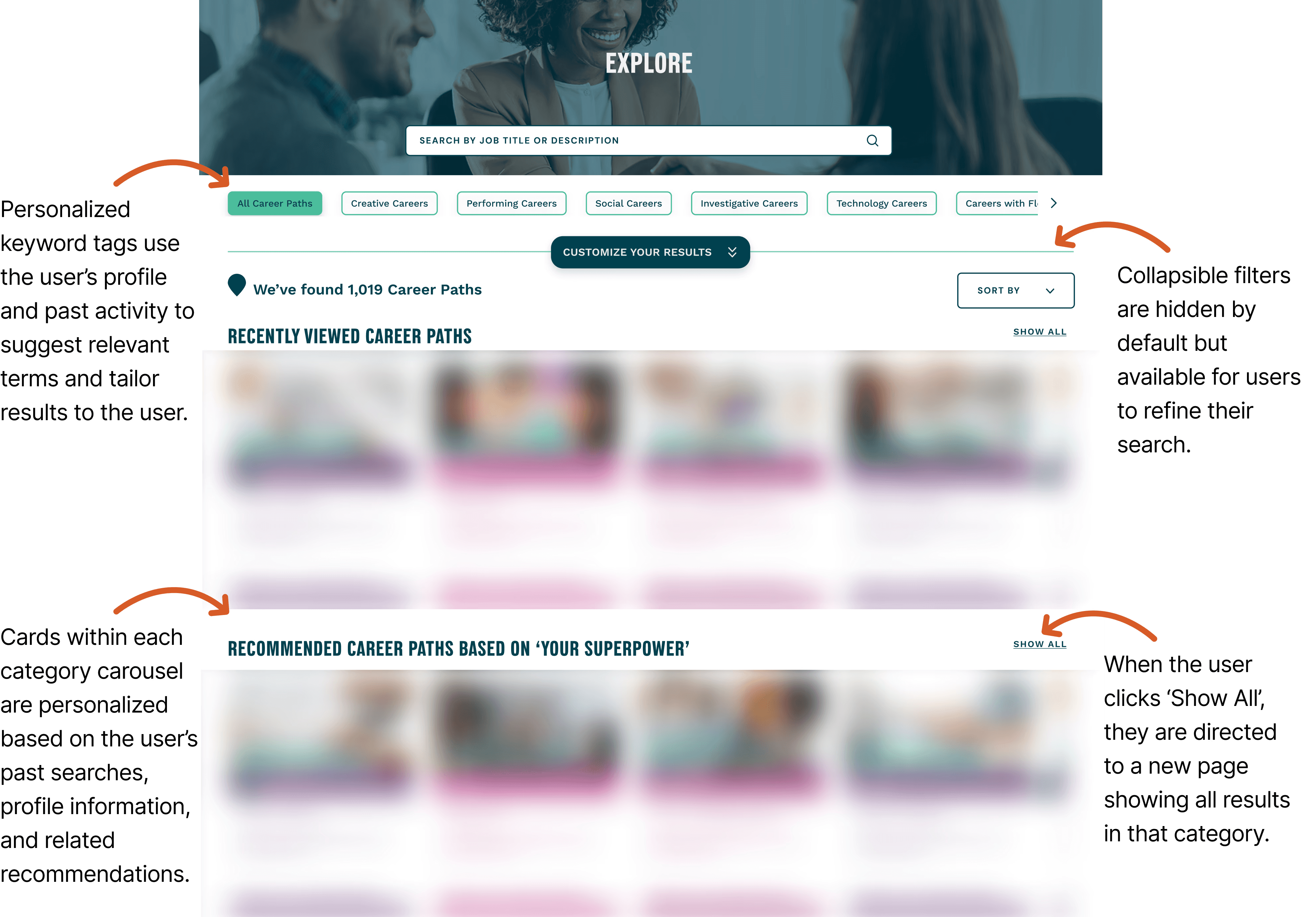
This concept also revealed an opportunity to surface related careers, jobs, certifications, and courses within a single discovery experience.
This concept also revealed an opportunity to surface related careers, jobs, certifications, and courses within a single discovery experience.
USER TESTING
USER TESTING
User testing revealed two AI models support different exploration behaviors and require clear separation from classic search.
User testing revealed two AI models support different exploration behaviors and require clear separation from classic search.
I tested both AI models with 5 participants, each completing two tasks per model, including searching and filtering career paths. The goal was to understand user preference between conversational AI and recommendation based exploration, and evaluate how each model affected clarity, engagement, and perceived usefulness.
I tested both AI models with 5 participants, each completing two tasks per model, including searching and filtering career paths. The goal was to understand user preference between conversational AI and recommendation based exploration, and evaluate how each model affected clarity, engagement, and perceived usefulness.
I tested both AI models with 5 participants, performing 2 tasks on each model including searching for and filtering a result. The goal of testing was to understand user preference between conversational AI and recommendation-based exploration, and to evaluate how each model affected clarity, engagement, and perceived usefulness
Key Findings
Key Findings
Overlapping AI and classic search caused confusion.
Overlapping AI and classic search caused confusion.
Fixed chatbot conversation window disrupted browsing, and users often missed when results updated.
Fixed chatbot conversation window disrupted browsing, and users often missed when results updated.
The chatbot model emphasized interaction, while the recommendation model encouraged browsing.
The chatbot model emphasized interaction, while the recommendation model encouraged browsing.
The recommendation model scored higher in intuitiveness and satisfaction, but users preferred the chatbot for goal-oriented tasks.
The recommendation model scored higher in intuitiveness and satisfaction, but users preferred the chatbot for goal-oriented tasks.
Key Takeaway:
Integrating AI works best when chatbot interaction is separated from classic search while recommendations support browsing alongside it.
Key Takeaway:
Integrating AI works best when chatbot interaction is separated from classic search while recommendations support browsing alongside it.
Limitation
Limitation
Non-representative Sample
Non-representative Sample
Participants were computing students comfortable with AI, which may have influenced adoption. Testing with high school students is needed to validate findings.
Participants were computing students comfortable with AI, which may have influenced adoption. Testing with high school students is needed to validate findings.
FINAL DESIGN
FINAL DESIGN
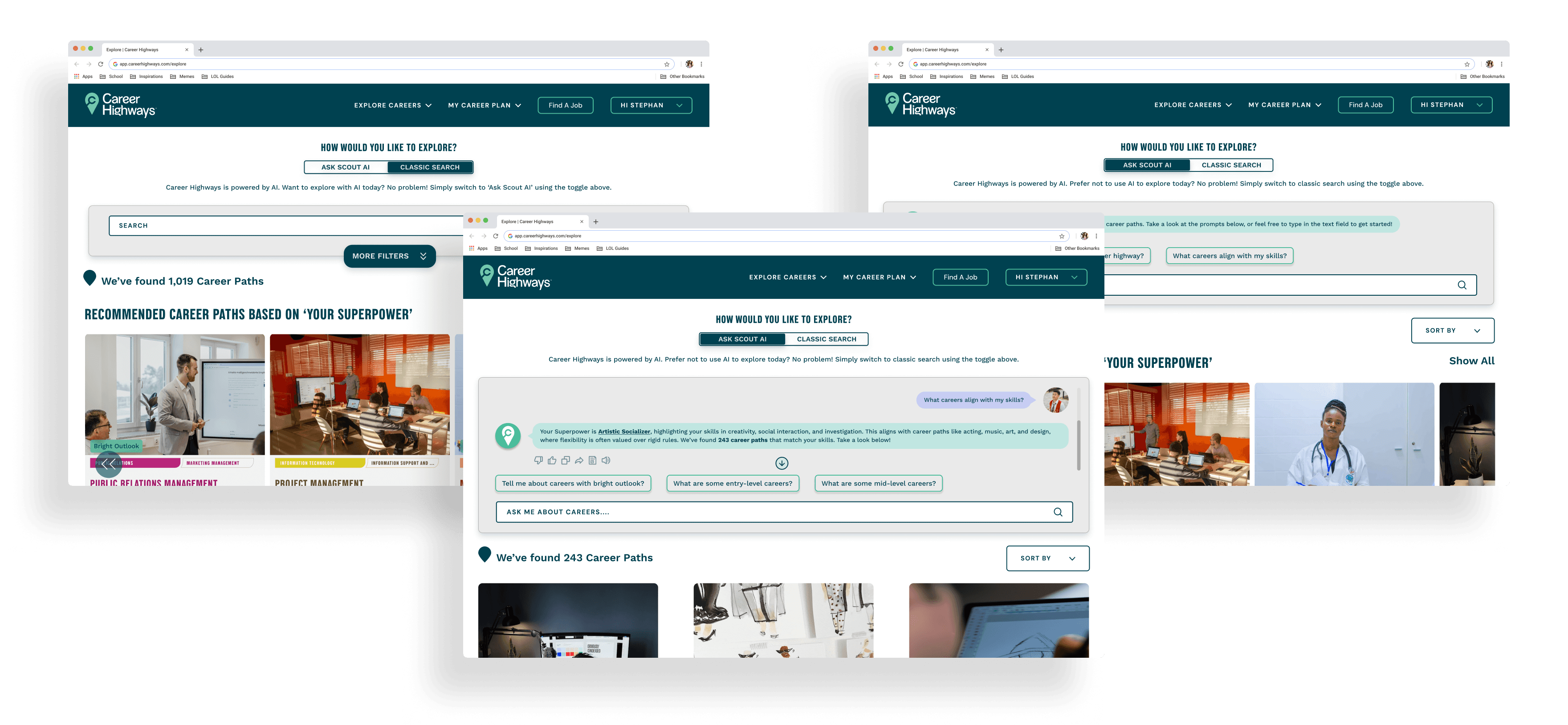
Combining chatbot and recommendation models unified exploration while preserving classic search via a toggle.
Combining chatbot and recommendation models unified exploration while preserving classic search via a toggle.
Testing showed that no single AI model supported every exploration behavior. Instead of choosing one direction, I recommended a combined approach and created a semi-interactive prototype integrating both AI models while clearly separating AI from classic search.
Testing showed that no single AI model supported every exploration behavior. Instead of choosing one direction, I recommended a combined approach and created a semi-interactive prototype integrating both AI models while clearly separating AI from classic search.
Key Design Changes
Key Design Changes
Simplified Layout
Simplified Layout
Removed the hero banner and consolidated Explore pages to one unified page.
Removed the hero banner and consolidated Explore pages to one unified page.
Preserved keyword search and filters in classic search mode only.
Preserved keyword search and filters in classic search mode only.
AI mode includes a chatbot conversation window and AI generated recommendations.
AI mode includes a chatbot conversation window and AI-generated recommendations.
Guided Exploration
Guided Exploration
Adding recommendation carousels support browsing and discovery.
Adding recommendation carousels support browsing and discovery.
Sticky chatbot conversation window for easier reference.
Sticky chatbot conversation window for easier reference.
Summarize results in the conversation window with visual signals directing users to browse below.
Summarize results in the conversation window with visual signals directing users to browse below.
This approach consolidated fragmented exploration into a single experience and separated AI from classic search, clarifying how the system works while preserving familiar search behavior.
This approach consolidated fragmented exploration into a single experience and separated AI from classic search, clarifying how the system works while preserving familiar search behavior.
CONCLUSION
CONCLUSION
Combining two AI models can make the Explore experience more efficient, personalized, and unified.
Combining two AI models can make the Explore experience more efficient, personalized, and unified.
Impact
Impact
This project demonstrated how AI can enhance career exploration without disrupting familiar traditional search behaviors, and revealed an opportunity to unify four fragmented Explore pages. Comparing chatbot and recommendation models clarified how different AI patterns support different exploration goals, informing a direction that balances active conversation and passive browsing.
This project demonstrated how AI can enhance career exploration without disrupting familiar traditional search behaviors, and revealed an opportunity to unify four fragmented Explore pages. Comparing chatbot and recommendation models clarified how different AI patterns support different exploration goals, informing a direction that balances active conversation and passive browsing.
Retrospective
Retrospective
If I were to approach this project again, I would invest more time in early user research and competitive analysis to clarify user goals before designing AI solutions. Although I raised layout concerns early and suggested a collapsible AI pattern, I wish I had more time and stronger influence to communicate the tradeoffs and validate alternative layouts through testing. This may have led to a solution that better balanced AI visibility and browsing efficiency.
If I were to approach this project again, I would invest more time in early user research and competitive analysis to clarify user goals before designing AI solutions. Although I raised layout concerns early and suggested a collapsible AI pattern, I wish I had more time and stronger influence to communicate the tradeoffs and validate alternative layouts through testing. This may have led to a solution that better balanced AI visibility and browsing efficiency.